
This movie was released last year but can now be streamed online. It's one of the best summaries of a growing problem we have in this country that is totally solvable.

Wednesday, January 22, 2014


Sunday, January 12, 2014
Kale and Thyroid Concerns
From WBUR, NPR:
The Dark Side Of Kale (And How To Eat Around It)
The headline in The New York Times made my heart sink: Kale? Juicing? Trouble Ahead.
Confession: I’m one of those Vitamix-loving, green-smoothie worshipping, kale bandwagoners. I brim with holier-than-thou pride when my kids eat raw kale (no dressing, even!) and thick kale-laden shakes while other children snack on sugary GoGURT squeezes and suck on juice boxes.
I am not alone. Presidents and stars are kale-lovers too.
Kale, in case you haven’t noticed, is health-conscious America’s “it” vegetable. Raw, blended, sauteed or in chip or “crunch” form, it appears to be the manna of celebrities: Gwyneth and Jennifer devour it while Kevin Bacon recently declared [it's] “the age of kale.” In an astutely reported feature called Stars Who Love Kale, US Weekly quotes Bette Midler saying: “Kale is burning up the veggisphere.”
Even the Obamas dined on kale salad at their Thanksgiving feast, notes The Washington Post.
But apparently there’s trouble in cruciferous paradise.
Writing for The Times, Jennifer Berman reports on the dark side of kale, and how the health-infused, veggie Eden she’d carefully built over years began to crumble:
Well, yes, possibly. Here’s the science-y low-down on the kale-thyroid connection from the Oregon State University Micronutrient Information site:
Fung adds: “It’s the dose that makes a poison. If people have hypothyroidism or they’re taking thyroid medication, then they should check with their doctor. But even in this case, reasonable amounts shouldn’t be a problem. Now, if people have a tall glass of kale juice every single day, then it gets into the unknown territory.”
So, what are still-anxious kale-lovers to do? I asked Somerville health coach and psychology of eating coach Nina Manolson to offer some guidance. (She’s not a doctor, but she knows a lot about food, so keep that in mind and always check with a professional if you make major changes in your diet.)
Nina reiterated that kale is a goitergenic food – meaning that it can contribute to an enlarged thyroid – a goiter. A goiter indicates that the thyroid gland is not functioning optimally. But, she says, there are ways to have our kale and eat it too. Here, lightly edited, are her suggestions:
1. Cook Your Kale
The goitergenics properties of kale become dramatically lessened when kale — or any other cruciferous vegetable — is cooked. (Other veggies in this category include: broccoli, brussel sprouts, cabbage, cauliflower, collard greens, kohlrabi, mustard, rutabaga, turnips, bok choy, and Chinese cabbage. Arugula, horse radish, radish, wasabi and watercress are also cruciferous vegetables.)
2. Eat Seaweed
Kale on its own does not increase the risk of thyroid problems. It’s a combination of factors; including potential iodine deficiency. (One of the most common causes of goiters is iodine deficiency.) Adding seaweed or another iodine rich food to your diet may, in some cases, help you get adequate iodine.
3. Throw A Brazil Nut Into Your Smoothie
Selenium can support normal iodine levels which in turn may support a healthy thyroid. A Brazil nut or two in your daily smoothie or as a topping to any dish might help keep selenium levels strong.
4. Switch Up Your Greens
Vary your greens. If you’re going to eat kale one day choose a non-cruciferous, non-goitergenic veggie dish the next, like a simple cucumber and tomato salad, or beets. There are many highly nutritious vegetables that aren’t goitergenic, including celery, parsley, zucchini, carrots and more. Our bodies need many nutrients and by eating a variety of vegetables you’ll ensure that you don’t overload on one and skip another.
Nina adds:
Confession: I’m one of those Vitamix-loving, green-smoothie worshipping, kale bandwagoners. I brim with holier-than-thou pride when my kids eat raw kale (no dressing, even!) and thick kale-laden shakes while other children snack on sugary GoGURT squeezes and suck on juice boxes.
I am not alone. Presidents and stars are kale-lovers too.
Kale, in case you haven’t noticed, is health-conscious America’s “it” vegetable. Raw, blended, sauteed or in chip or “crunch” form, it appears to be the manna of celebrities: Gwyneth and Jennifer devour it while Kevin Bacon recently declared [it's] “the age of kale.” In an astutely reported feature called Stars Who Love Kale, US Weekly quotes Bette Midler saying: “Kale is burning up the veggisphere.”
Even the Obamas dined on kale salad at their Thanksgiving feast, notes The Washington Post.
But apparently there’s trouble in cruciferous paradise.
Writing for The Times, Jennifer Berman reports on the dark side of kale, and how the health-infused, veggie Eden she’d carefully built over years began to crumble:
Imagine my shock, then, at my last physical, when my doctor told me I had hypothyroidism, common in women over 40. When I got home I looked up the condition on the Internet and found a list of foods to avoid. Kale, which I juiced every morning, tops the list, followed by broccoli, cauliflower, cabbage, Brussels sprouts and collard greens — the cruciferous vegetables I consumed in large quantities because they are thought to prevent cancer, which runs in my family. And flax — as in the seeds — high in omega 3’s, that I sprinkled on cereal and blended in strawberry almond milk smoothies. Also forbidden: almonds and strawberries, not to mention soy, peaches, peanuts, corn, radishes, rutabaga and spinach.My first reaction: Berman must be misguided, mistaken. Can kale possibly be bad?
Well, yes, possibly. Here’s the science-y low-down on the kale-thyroid connection from the Oregon State University Micronutrient Information site:
Very high intakes of cruciferous vegetables…have been found to cause hypothyroidism (insufficient thyroid hormone) in animals (68). There has been one case report of an 88-year-old woman developing severe hypothyroidism and coma following consumption of an estimated 1.0 to 1.5 kg/day of raw bok choy for several months. Two mechanisms have been identified to explain this effect. The hydrolysis of some glucosinolates found in cruciferous vegetables (e.g., progoitrin) may yield a compound known as goitrin, which has been found to interfere with thyroid hormone synthesis. The hydrolysis of another class of glucosinolates, known as indole glucosinolates, results in the release of thiocyanate ions, which can compete with iodine for uptake by the thyroid gland. Increased exposure to thiocyanate ions from cruciferous vegetable consumption or, more commonly, from cigarette smoking, does not appear to increase the risk of hypothyroidism unless accompanied by iodine deficiency. One study in humans found that the consumption of 150 g/day (5 oz/day) of cooked Brussels sprouts for four weeks had no adverse effects on thyroid function.Teresa Fung, Sc.D., M.S.. an adjunct professor of nutrition at the Harvard School of Public Health and a professor at Simmons College in Boston, confirms the kale-thyroid link. But, she says, “normal, reasonable amounts of eating should not be a problem. A regular person [with no thyroid issues] who eats several servings of cruciferous vegetables a week should not have problems.”
Fung adds: “It’s the dose that makes a poison. If people have hypothyroidism or they’re taking thyroid medication, then they should check with their doctor. But even in this case, reasonable amounts shouldn’t be a problem. Now, if people have a tall glass of kale juice every single day, then it gets into the unknown territory.”
So, what are still-anxious kale-lovers to do? I asked Somerville health coach and psychology of eating coach Nina Manolson to offer some guidance. (She’s not a doctor, but she knows a lot about food, so keep that in mind and always check with a professional if you make major changes in your diet.)
Nina reiterated that kale is a goitergenic food – meaning that it can contribute to an enlarged thyroid – a goiter. A goiter indicates that the thyroid gland is not functioning optimally. But, she says, there are ways to have our kale and eat it too. Here, lightly edited, are her suggestions:
1. Cook Your Kale
The goitergenics properties of kale become dramatically lessened when kale — or any other cruciferous vegetable — is cooked. (Other veggies in this category include: broccoli, brussel sprouts, cabbage, cauliflower, collard greens, kohlrabi, mustard, rutabaga, turnips, bok choy, and Chinese cabbage. Arugula, horse radish, radish, wasabi and watercress are also cruciferous vegetables.)
2. Eat Seaweed
Kale on its own does not increase the risk of thyroid problems. It’s a combination of factors; including potential iodine deficiency. (One of the most common causes of goiters is iodine deficiency.) Adding seaweed or another iodine rich food to your diet may, in some cases, help you get adequate iodine.
3. Throw A Brazil Nut Into Your Smoothie
Selenium can support normal iodine levels which in turn may support a healthy thyroid. A Brazil nut or two in your daily smoothie or as a topping to any dish might help keep selenium levels strong.
4. Switch Up Your Greens
Vary your greens. If you’re going to eat kale one day choose a non-cruciferous, non-goitergenic veggie dish the next, like a simple cucumber and tomato salad, or beets. There are many highly nutritious vegetables that aren’t goitergenic, including celery, parsley, zucchini, carrots and more. Our bodies need many nutrients and by eating a variety of vegetables you’ll ensure that you don’t overload on one and skip another.
Nina adds:
If you don’t have a thyroid issue, kale can and should be a delicious and healthy part of your diet because it is, indeed, a nutritional superstar with excellent credentials:All of this leaves me wishing that eating were just, well, simpler. With no arsenic in the rice and no flip-flopping guidance on milk, soy, whatever, from the experts. It reminds me (and several commenters on The Times‘ kale story) of that looming prophet of health, Woody Allen, and this scene from his film, Sleeper:
•It supports strong bones because of its high calcium content.
•It’s a potential immune booster, rich in Vitamin C
•It may protect us against cancer because it’s packed with anti-oxidants and as mentioned, it’s a cruciferous vegetable.
•It’s high in iron which can support blood and energy levels.
•And of course, it’s packed with fiber so it’s great for digestion.
Dr. Melik: This morning for breakfast he requested something called “wheat germ, organic honey and tiger’s milk.”
Dr. Aragon: [chuckling] Oh, yes. Those are the charmed substances that some years ago were thought to contain life-preserving properties.
Dr. Melik: You mean there was no deep fat? No steak or cream pies or… hot fudge?
Dr. Aragon: Those were thought to be unhealthy… precisely the opposite of what we now know to be true.
Dr. Melik: Incredible.
Friday, January 10, 2014
Stop Citizen's United - Sign Kay Hagan's Petition vs. Citizen's United
STOP CITIZENS UNITED!
Citizens United opened the floodgates for outside special interest groups, run by the likes of Karl Rove and the Koch brothers, to dominate the conversation around our elections. There’s no transparency. There’s no accountability. And it needs to end.
Urge Congress to reverse the effects of Citizens United — sign the petition.
Members of Congress:It’s time we put an end to limitless corporate cash in our elections.Elections should be about the people and their interests, not the powerful and their bank accounts.It’s time for Congress to end the disastrous effects of Citizens United, and restore accountability and transparency to our campaign finance system.Signed,
[Your Name Here]
Daily kos, FRI NOV 15, 2013 AT 07:52 AM PST
NC-Sen: Kay Hagan (D) Highlights The Negative Effects Citizens United Has Had On North Carolina
You’ve all heard of Citizens United -- the Supreme Court decision that paved the way for Super PACs and out-of-touch special interests to spend millions of dollars in our elections with no transparency.
North Carolinians have seen the damage of all that secretive spending. According to theCenter for Public Integrity, our state judicial races in 2012 were “rocked” by the Citizens United decision. And we’ve already seen the outside interests hard at work in our race, launching attacks on TV, online, even on billboards to influence North Carolinians.
It’s not a secret to anyone: Our campaign finance system is broken. It’s far past time we took steps to fix it.
I’m joining with a group of my colleagues to call for an end to the effects of Citizens United, and we need you to join us. Can you sign the petition right now?
* * * *
Kay Hagan, junior and first term U.S. Senator from North Carolina in 2014, is in many ways one of the most progressive Democrats to come out of the Carolinas in a long time. Elected in the wake of President Obama's 2008 victory, her labor union ratings are good, and her candidacy deserves support. A Washington Post article, "Can Sen. Kay Hagan can get away with what other red state Democrats can’t?," noted her braving conservative region conventions: among other issues, she has declared her support for marriage equality.
It will be a tough campaign. Elizabeth Dole has already come out with sleaze attacks attacking her religious beliefs. But Hagan's not backing down, and has ads of her own.
It will be a tough campaign. Elizabeth Dole has already come out with sleaze attacks attacking her religious beliefs. But Hagan's not backing down, and has ads of her own.
Thursday, January 9, 2014
Sick of NPR's Pro-fracking ads on the Radio?

Tell NPR to drop the Fracking Ads
Sick of NPR's Pro-fracking ads on
the Radio?
It might surprise you that one of NPR's biggest corporate sponsors is the American
Natural Gas Alliance,
a front group for some of the worst polluters in America.
a front group for some of the worst polluters in America.
Fracking for natural gas puts America on a path toward a bleak energy future, with polluted land, flammable tap water and earthquakes.
Even worse, NPR's financial dependence on the fracking industry could be fouling its news coverage, just like fracking fouls up our air, water and climate.
Sign Environmental Action's online petition.
Please sign this important petition on globalization, Trans-Pacific Partnership from SumOfUS
Please sign this important petition on globalization from SumOfUS, SumOfUs is a movement of consumers, workers and shareholders speaking with one voice to counterbalance the growing power of large corporations. Join us on our journey as we seek to make the world a better place for ourselves, our children and all who share our planet.
Our democracy could suffer a huge blow this month -- Congress is preparing to sign away its authority on the Trans-Pacific Partnership, a trade deal that reads like a corporate lobbyist’s wildest dream.
The TPP would make it easier for corporations to sue our government, prevent regulation of GMOs, and keep people in impoverished countries from accessing life-saving medicines. And worst of all, the full text of the deal has been kept secret from the public, and even Congress doesn’t have full access -- even though hundreds of corporate lobbyists who have helped write the agreement do!
Now President Obama is trying to ram this deal through by seeking “fast-track” authority, which would prevent Congress from making any changes to the deal and stifle any debate. Members of Congress from both sides of the aisle have spoken out against fast track authority, and if we can get more Democrats to join them, we’ll have a real chance to stop this corporate power grab.
Rep. Sandy Levin is key. He’s the top Democrat on the congressional committee that's responsible for trade policy, but he’s breaking with most of the party to support a fast-track bill. Can you call his office today and tell him to stop fast-track?
The Trans-Pacific Partnership (TPP) is called a trade deal, but it's really a corporate wish-list aimed at attacking everything from environmental protections to affordable medicines to internet freedoms.
If the deal is signed, future laws designed to protect consumers, our health or our environment could be challenged by corporations that claim that the law reduces their profit -- and there is nothing we or our governments could do to stop them.
Corporate lobbyists and government insiders are keeping the text of the deal secret because they know that if the full details got out into public view, we wouldn't like what we saw. Even Congress can’t see the bill, but the Obama administration wants authority to negotiate without any oversight. But we already know enough through leaks to know it's really bad. We can't let this sail through without public scrutiny, and the only way we can give the public time to review the bill is by stopping fast track now!
Can we count on you to call Rep. Levin and tell him not to let the TPP sail through without real oversight?.
Thanks for all you do,
Kaytee, Paul, Rob, and the team at SumOfUs
Kaytee, Paul, Rob, and the team at SumOfUs
Thursday, December 26, 2013
Facebook Got Multi-billion Dollar Tax break; Yet Dictates Public Policy
Facebook made over $1 billion in
profits this year [2013] but won't be paying any taxes. Instead, he company
will receive a $429 million tax refund.
Facebook won’t pay taxes again, will get refund instead
Published time: December 19, 2013 16:25 in Russia Today
Edited time: December 19, 2013 17:33
Edited time: December 19, 2013 17:33
http://rt.com/usa/coburn-wastebook-facebook-taxes-503/
. . . .
. . . .
From Citizens for Tax Justice, a progressive group on tax issues:


Earlier this month, the Facebook Inc
Tuesday, December 24, 2013
Warning: A "Natural" Fetish is Harmful to Your Health - Collide-a-Scape | DiscoverMagazine.com
Warning: A "Natural" Fetish is Harmful to Your Health - Collide-a-Scape | DiscoverMagazine.com


Warning: A “Natural” Fetish is Harmful to Your Health
Last week an expert panel of physicians advised Americans to “stop wasting money” on multivitamins:
We believe that the case is closed— supplementing the diet of well-nourished adults with (most) mineral or vitamin supplements has no clear benefit and might even be harmful. These vitamins should not be used for chronic disease prevention. Enough is enough.
Good luck with that. As the New York Times notes,
Demand for vitamin and mineral supplements has grown markedly in recent years, with domestic sales totaling some $30 billion in 2011.
(It’s a big business in the UK, too.)
Naturally (pun intended), the Natural Products Association, the industry trade group for this modern-day snake oil, was none too happy, insisting that dietary supplements “are overwhelmingly safe.” Not that they would know, of course, since the vast majority of the products are unregulated. As for their safety, the Times ran a front page piece on this issue yesterday:
Dietary supplements account for nearly 20 percent of drug-related liver injuries that turn up in hospitals, up from 7 percent a decade ago, according to an analysis by a national network of liver specialists. The research included only the most severe cases of liver damage referred to a representative group of hospitals around the country, and the investigators said they were undercounting the actual number of cases.While many patients recover once they stop taking the supplements and receive treatment, a few require liver transplants or die because of liver failure. Naïve teenagers are not the only consumers at risk, the researchers said. Many are middle-aged women who turn to dietary supplements that promise to burn fat or speed up weight loss.“It’s really the Wild West,” said Dr. Herbert L. Bonkovsky, the director of the liver, digestive and metabolic disorders laboratory at Carolinas HealthCare System in Charlotte, N.C. “When people buy these dietary supplements, it’s anybody’s guess as to what they’re getting.”
Gee, so much for that precautionary principle I keep hearing about from organic, anti-GMO folks. Speaking of, where are the consumer watchdogs and health advocates who are so obsessed with genetically modified foods? Surely, this Wild West of health products would be of concern to them?
Not surprisingly, the Natural Products Association has jumped aboard the GMO labeling movement:
This is really very simple – people have a right to know what’s in their food.
People also have a right to know if pills branded as “natural” might destroy their insides.
As the Times piece says,
unlike prescription drugs, which are tightly regulated, dietary supplements typically carry no information about side effects. Consumers assume they have been studied and tested, Dr. Bonkovsky said. But that is rarely the case. “There is this belief that if something is natural, then it must be safe and it must be good,” he said.
Gee, I wonder where consumers get that idea from?
Marc Gunther explains it well and also suggests:
The challenge for all of us is to get beyond the simple dichotomies that characterize so much conversation around food. Natural vs. processed. Local vs. global. Small vs. big. Genetically-modified vs. conventionally bred. Organic vs. everything else.
I’m all for that. Meanwhile, I’ll be looking for the champions in the Food Movement to take on the existing fuzzy labels, dubious health claims and very real dangers of the “natural” food products industry.
Friday, December 13, 2013
State conservative groups plan US-wide assault on education, health and tax policies - Guardian report on State Policy Network
State conservative groups plan US-wide assault on education, health and tax
• State Policy Network co-ordinating plans across 34 US states
• Strategy to 'release residents from government dependency'
• Revelations come amid growing scrutiny of tax-exempt charities
• Read key excerpts from the SPN proposals
• Portland Press Herald: group's plan to eliminate taxes
• Texas Observer: the money behind the fight to wreck Medicaid
• Strategy to 'release residents from government dependency'
• Revelations come amid growing scrutiny of tax-exempt charities
• Read key excerpts from the SPN proposals
• Portland Press Herald: group's plan to eliminate taxes
• Texas Observer: the money behind the fight to wreck Medicaid
Conservative groups across the US are planning a co-ordinated assault against public sector rights and services in the key areas of education, healthcare, income tax, workers' compensation and the environment,documents obtained by the Guardian reveal.
The strategy for the state-level organisations, which describe themselves as "free-market thinktanks", includes proposals from six different states for cuts in public sector pensions, campaigns to reduce the wages of government workers and eliminate income taxes, school voucher schemes to counter public education, opposition to Medicaid, and a campaign against regional efforts to combat greenhouse gas emissions that cause climate change.
The policy goals are contained in a set of funding proposals obtained by the Guardian. The proposals were co-ordinated by the State Policy Network, an alliance of groups that act as incubators of conservative strategy at state level.
The documents contain 40 funding proposals from 34 states, providing a blueprint for the conservative agenda in 2014. In partnership with the Texas Observer and the Portland Press Herald in Maine, the Guardian is publishing SPN's summary of all the proposals to give readers and news outlets full and fair access to state-by-state conservative plans that could have significant impact throughout the US, and to allow the public to reach its own conclusions about whether these activities comply with the spirit of non-profit tax-exempt charities.
Details of the co-ordinated approach come amid growing federal scrutiny of the political activities of tax-exempt charities. Last week the Obama administration announced a new clampdown on those groups that violate tax rules by engaging in direct political campaigning.
Most of the "thinktanks" involved in the proposals gathered by the State Policy Network are constituted as 501(c)(3) charities that are exempt from tax by the Internal Revenue Service. Though the groups are not involved in election campaigns, they are subject to strict restrictions on the amount of lobbying they are allowed to perform. Several of the grant bids contained in the Guardian documents propose the launch of "media campaigns" aimed at changing state laws and policies, or refer to "advancing model legislation" and "candidate briefings", in ways that arguably cross the line into lobbying.
The documents also cast light on the nexus of funding arrangements behind radical rightwing campaigns. The State Policy Network (SPN) has members in each of the 50 states and an annual warchest of $83m drawn from major corporate donors that include the energy tycoons the Koch brothers, the tobacco company Philip Morris, food giant Kraft and the multinational drugs company GlaxoSmithKline.
SPN gathered the grant proposals from the 34 states on 29 July. Ranging in size from requests of $25,000 to $65,000, the plans were submitted for funding to the Searle Freedom Trust, a private foundation that in 2011 donated almost $15m to largely rightwing causes.
The trust, founded in 1998, draws on the family fortune of the late Dan Searle of the GD Searle & Company empire – now part of Pfizer – which created NutraSweet. The trust is a major donor to such mainstays of the American right and the Tea Parties as Americans for Prosperity, the American Legislative Exchange Council (Alec), the Heartland Institute and the State Policy Network itself.
SPN's link to Searle, the Guardian documents show, was Stephen Moore, an editorial writer with the Wall Street Journal. Moore, who advises Searle on its grant-giving activities, was asked by SPN to rank the proposals in two halves – a "top 20" and "bottom 20". It is not known how many of the 40 proposals were approved for funding, nor which may have been successful.
Moore told the Guardian that he is an unpaid adviser to the Searle Foundation, having been a lifetime family friend to Dan Searle. He said the grant decisions were made by Searle's sons and grandsons based upon the late businessman's "commitment to the advancement of free enterprise and individual rights".
The proposals in the grant bids contained in the Guardian documents go beyond a commitment to free enterprise, however. They include:
• "reforms" to public employee pensions raised by SPN thinktanks in Arizona, Colorado, Minnesota, Missouri, New Jersey and Pennsylvania;
• tax elimination or reduction schemes in Alabama, Arkansas, Georgia, Maryland, Nebraska and New York;
• an education voucher system to promote private and home schooling in Florida;
• campaigns against worker and union rights in Delaware and Nevada;
• opposition to Medicaid in Georgia, North Carolina and Utah.
SPN's president, Tracie Sharp, told the Guardian that "as a pro-freedom network of thinktanks, we focus on issues like workplace freedom, education reform, and individual choice in healthcare: backbone issues of a free people and a free society."
In its grant bid, the Maine Heritage Policy Center asked for $35,000 to support a "research and demonstration project" that would "release residents from extreme government dependency". It would turn the state's poorest area into what the Portland Press Herald describes in its report from Washington County as "a gigantic tax-free zone".

Dubbed "FreeME", the initiative would eliminate state income tax and sale taxes from residents and businesses until the economic conditions in the county rise to the statewide average. The hole in the county's income from lost tax revenues – estimated at $35m a year by the think tank – would be filled through budget cuts.
Medicaid is the target of a grant proposal coming from the Texas Public Policy Foundation (TPPF), an influential thinktank funded largely by rightwing foundations and corporations including the energy tycoons the Koch brothers, tobacco company Altria and the telecoms giant Verizon. The Texas Observer has investigated the contents of the document and points out that in its request for $40,000 from Searle, TPPF claims credit for blocking Medicaid expansion in the state.
"[S]topping Medicaid expansion is just the first step," the proposal says, adding that the "missing piece to complete our message is an economic forecast" showing how block-granting Medicaid would "bring significant savings" to the state. That information would then be used to garner attention from the media.
The Observer describes TPPF as "one of the most influential state-level thinktanks in the nation". One of its former executives was Ted Cruz, now US senator for Texas, who today is the keynote speaker at the national conference in Washington of SPN's sister organisation, the American Legislative Exchange Council (Alec).
Several hundred miles to the north east in Massachusetts, the Beacon Hill Institute requested $38,825 from Searle to weaken or roll back a five-year effort by states in the region to reduce greenhouse gas emissions. The institute said it would carry out research into the economic impact of the cap-and-trade system operating in nine states known as the Regional Greenhouse Gas Initiative.
BHI appeared to have already arrived at its conclusions in advance, admitting from the outset that the aim of the research was to arm opponents of cap-and-trade with data for their arguments, and to weaken or destroy the initiative. "Success will take the form of media recognition, dissemination to stakeholders, and legislative activity that will pare back or repeal RGGI," the funding proposal says.
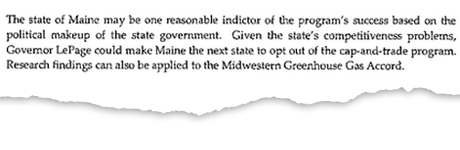
The Beacon Hill Institute, technically an affiliate rather than a full member of the SPN, operates out of the economics department of Suffolk University in Boston. David Tuerck, its executive director, denied the group had engaged in lobbying. "There is never any lobbying," he told the Guardian. "Maybe I need to look up the definition again, but lobbying consists of buttonholing legislators and other policymakers to get a particular result on a particular issue, and we never do that."
But Suffolk University, which hosts the Beacon Hill Institute as a research arm of its economics department, sharply criticised the research proposal to the Searle Foundation. In a statement to the Guardian, the university said the grant bid had not been submitted to the university, as required, and that the university would never have approved the proposal. "The stated research goals, as written, were inconsistent with Suffolk University's mission."
Watchdogs that monitor the work of SPN and other conservative networks in the US said that the centralised coordination of state-level campaigns showed a significant attempt to build local activism into a nationwide movement. Lisa Graves, executive director of the Center for Media and Democracy, which issued a recent report on SPN, said that the local identity of the network's members belied a larger purpose. "They appear to be advocating purely local interests but what they are promoting is part of a larger national template to radically remake our government in a way that undermines public institutions and the rights of workers," she said.
The SPN said that its co-ordinating role was justified because local and state issues were increasingly impinging on national politics. "There's no mystery here," Sharp said. "The whole idea of a state policy network is that individual thinktanks can be in communication, share best practices and analysis, and combine their efforts when they see a benefit from doing so."
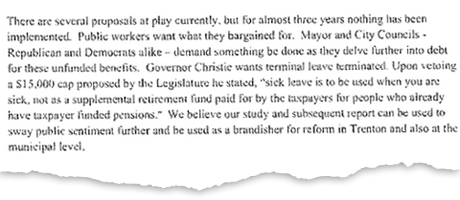
Some of the grant bids to Searle focus specifically on prominent local politicians the thinktanks hope to influence. The grant bid that emanated from New Jersey, from the Common Sense Institute (CISNJ), another tax-exempt "research and education organization", floats the idea of a campaign to support the efforts of the Republican governor Chris Christie in ending the ability of public employees to claim untaken sick days and vacation leave in their retirement packages.
"Governor Chris Christie has been waging a war to eliminate this practice; and CSINJ would like to provide ammunition," the proposal says. The thinktank plans to produce a "research study" which it would call "Busting the Boat Checks" – an allusion to the phrase Christie uses to denote the watercraft retirees are claimed to buy on the back of sick and holiday leave payments.
The institute conceives a "media campaign" with its aim being the "full elimination of unused sick and vacation leave payouts".
"We believe our study can be used to sway public sentiment further and be used as a brandisher for reform in Trenton," it says.
CSINJ's president, Jerry Cantrell, denied that the grant bid involved any element of lobbying, insisting instead that his group was providing a service that in the past might have been done by the decimated local media.
"CSINJ is an education organization focused on providing the public with facts and the truth. We don't represent any interest besides the folks who are burdened by this practice – the taxpayers," he said.
He said the proposal was focused on the "abusive practice of accumulating sick or vacation day payments over an entire career and using them as retirement bonus. We've seen too many instances of high level individuals working out the door with $500,000-$750,000 claiming to have never missed a day in 30 years of employment."
The proposal from the Illinois Policy Institute for a campaign to deal with Chicago's government worker pensions crisis by switching to 401(k)-style retirement plans similarly focuses on a politician – in this case Mayor Rahm Emanuel. The proposal says that "Mayor Emanuel has privately expressed the need for 401(k)-style changes to truly achieve reform."
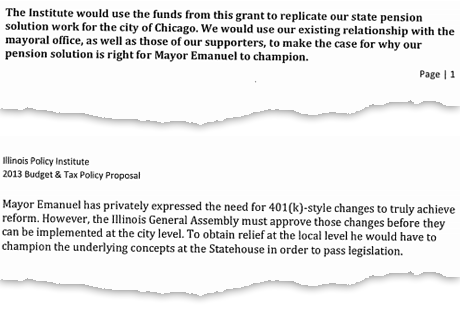
The institute plans to "leverage the leadership potential of Mayor Emanuel … as the spark for wider pension changes in Illinois." It adds that "friendly legislators would be welcome to draft legislation modelled on our policy work and work in tandem with Mayor Emanuel to move it forward in the legislative process."
John Tillman, CEO of the Illinois Policy Institute, told the Guardian that Emanuel had been "an outspoken proponent of pension reform that includes moving to a 401(k)-style, defined contribution system." He saw no problem with the lobbying that the think tank undertakes.
"We are not allowed to do any campaigning or electioneering, and we don't. We are allowed to spend a significant percentage of our expenditures on lobbying and we are very proactive in lobbying for liberty-based policy, including the urgently needed pension reform. We report our activities accordingly."
Wednesday, December 11, 2013
Real News Network: 1 out of 3 Bank Tellers in NY on Public Assistance
Jessica Desvarieux, of the Real News, December 9, 2013
New report finds bank executives receive big bonuses, while 39% of frontline bank employees must rely on welfare because of insufficient wages -December 9, 13
 JESSICA DESVARIEUX, TRNN PRODUCER: Welcome to The Real News Network. I'm Jessica Desvarieux in Baltimore.
Here's something you might not know. One in three bank employees in New York State are on public assistance. That's according to a new report released by New Day New York Coalition titledLeveraging New York's Financial Power to Combat Inequality. And this news comes almost two months after the University of California Berkeley Labor Center and University of Illinois published a study that said that more than 50 percent of fast food workers rely on public assistance programs due to their low wages.
Here to talk about the report is Deborah Axt. She's on the board of the Make the Road Action Fund, which together with New York Communities for Change, ALIGN, and Communications Workers of America from the Committee for Better Banks wrote the report.
Thanks for joining us, Deborah.
DEBORAH AXT, BOARD MEMBER, MAKE THE ROAD ACTION FUND: Thank you so much for having me.
DESVARIEUX: So, Deborah, can you just described for us the conditions for the average teller in the United States banking industry?
AXT: Yes. I mean, what we're talking about here are jobs that the public generally perceives to be entry-level jobs on a path to a professional career. And what they really are, often, is completely dead-end jobs, where workers are trapped in forcibly part-timed work, low-wage work, with high-pressure sales goals, sometimes wage theft, even. And, you know, these are really rough jobs. Workers report often being pressured to sell deals, products, bank accounts, credit cards that are not necessarily in the best interests of the clients, and that they realize this is true but have no ability to blow the whistle on these kinds of unethical practices at the banks.
DESVARIEUX: So what are your recommendations for alleviating some of these issues?
AXT: Well, the first thing is that we need to make sure that that workers have a path to speak out. We need to make sure that there are whistleblower protections in place in states and cities like New York and that we don't give out subsidies. Right now we're giving out hundreds of millions of dollars in subsidies to big banks in New York City and New York State alone with very little accountability for the job creation goals that are involved in those deals, and certainly with no checks with workers to make sure that they are being treated well and that their jobs are helping to lift people out of poverty.
DESVARIEUX: I'm sure there are some people listen to this saying that at the end of the day there needs to be some form of unionization. Is that your ultimate goal? Are you hoping that tellers eventually will organize themselves to form a union?
AXT: Make the Road, New York Communities for Change, ALIGN, and CWA that form the Committee for Better Banks have certainly had a long history of helping workers to organize into worker centers, into unions where appropriate. And so we believe strongly that workers need the right to organize and that they should be supported by the community members that we represent as well. And so we are here and would have their backs if that's what they choose.
This is just the first step at looking at this industry. We have been actively organizing in car washes and supermarkets and in fast food restaurants, but we've just turned our attention to the banking industry to see what was going on with workers there and were shocked to discover that the treatment in the banking industry is much like the treatment in other exploitative low-wage industries. But this is a place that you wouldn't expect it. This is the place where the boss, the CEO, is actually the boss of capitalism, right, the boss of our international economic system. You know, they're billionaires. They are well compensated. This is an industry that certainly can afford to treat workers properly, to treat workers with dignity.
1 out of 3 Bank Tellers in NY on Public Assistance
New report finds bank executives receive big bonuses, while 39% of frontline bank employees must rely on welfare because of insufficient wages -
If the video has no sound, check the volume slider in the bottom left of the video player and drag it to the right | |


| ||||||||||
  |
| |||||||||


Bio
Deborah Axt is on the Board of the Make the Road Action Fund, which together with New York Communities for Change, ALIGN, and the Communications Workers of America, form the Committee for Better Banks. Make the Road Action Fund and its sister organization, Make the Road New York, represent about 27,000 working class and immigrant New Yorkers through community organizing, policy design, and the provision of legal and survival services. Deborah is an attorney and is the lead architect of Make the Road's low wage worker organizing and policy work, leading low wage organizing in multiple sectors.
Transcript
JESSICA DESVARIEUX, TRNN PRODUCER: Welcome to The Real News Network. I'm Jessica Desvarieux in Baltimore.
Read the rest of the interview at http://therealnews.com/t2/index.php?option=com_content&task=view&id=31&Itemid=74&jumival=11156
Subscribe to:
Posts (Atom)


 Posts


