Showing posts with label police brutality. Show all posts

Saturday, August 16, 2014

A Careful, Progressive Legal Analysis: Was it legal for Darren Wilson to shoot Michael Brown?


 From Vox.com


Was it legal for Darren Wilson to shoot Michael Brown?

EVEN IF A ROBBERY DID TAKE PLACE, WILSON COULD STILL BE CHARGED WITH MURDER
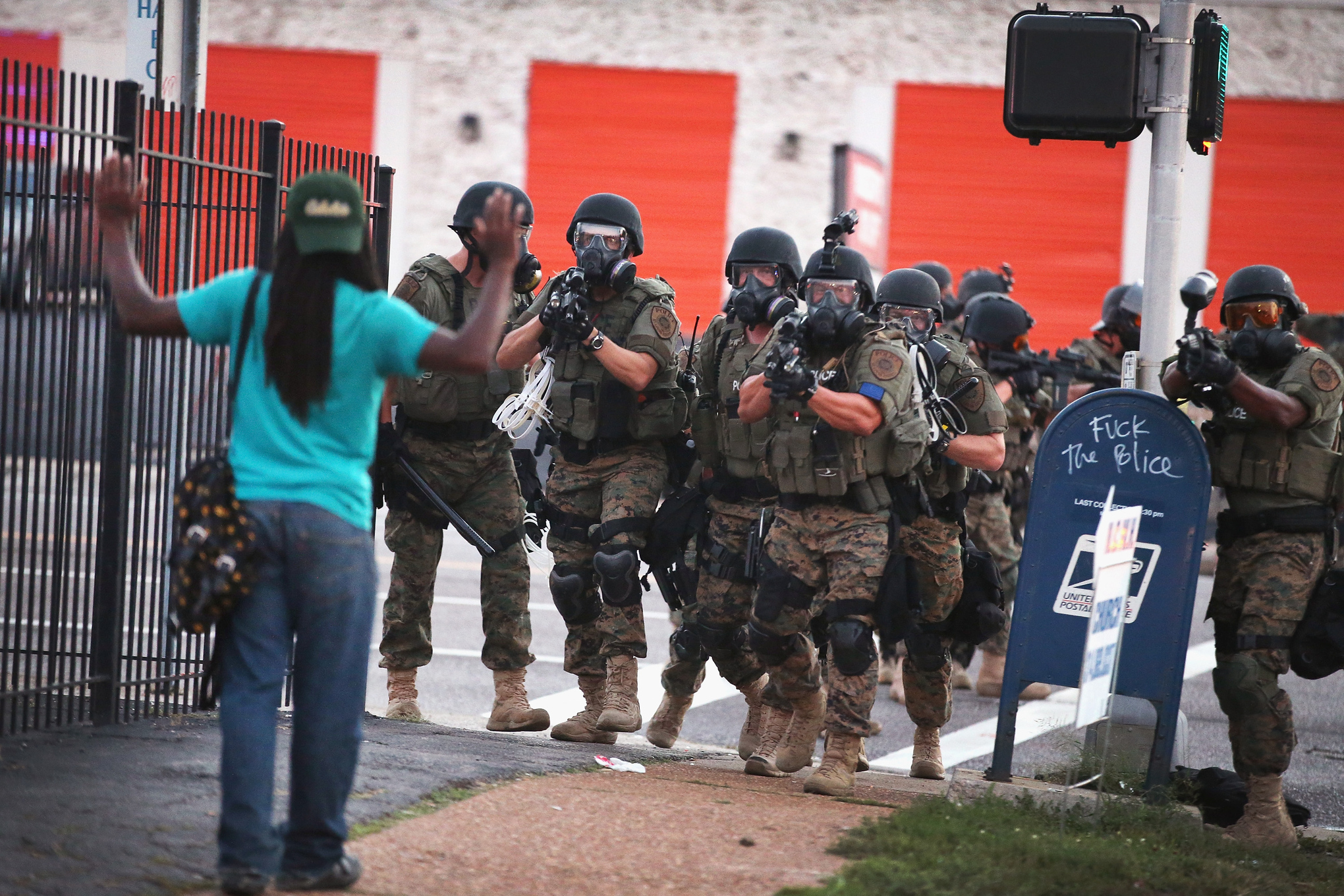
453505316On August 15, six days after the death of Michael Brown, the Ferguson Police Department finally identified the officer who shot Brown as Darren Wilson.
The department also released documents about the circumstances of the shooting — suggesting that Brown was the primary suspect in a "strong-arm robbery" of a convenience store shortly before Wilson encountered him. However, in a later press conference that same day, the Ferguson Police Chief clarified that officer Wilson did not know about the robbery at the time of his initial contact with Brown. Rather, Wilson stopped the teenager for walking in the middle of the street.
We don't yet know if Wilson became aware of the robbery in the few minutes between when he stopped Brown and when he shot him. However, even if he did, the documents released on Friday don't automatically exonerate Wilson. Even if Wilson believed that Brown was a suspect in a robbery, it's still possible that the police officer could be charged with murder or another crime for shooting Brown. And even if Wilson isn't charged with a crime, it's still possible he could be fired.
All of those things depend on the outcome of a criminal investigation currently being conducted by the St. Louis County Police Department.
That investigation is supposed to collect all the facts about what happened: There's the story Wilson gave the St. Louis County police on the weekend of the shooting, which is that Brown initiated a violent confrontation and tried to grab his gun. There's the conflicting story told by eyewitnesses, which is that Brown was shot twice while facing the officer with his hands up. There's also forensic evidence that could show which of those stories is true.
Once all of that is taken into account, it's up to St. Louis County prosecutor Bob McCulloch to determine whether a crime was committed, and it's on the police department to determine whether the officer should be fired.
So what are the standards by which Wilson will be judged for killing Michael Brown? There are plenty of guidelines for use of force by police, but it often boils down to what the officer believed when the force was used — something that is notoriously difficult to quantify — regardless of how much of a threat actually existed. We talked to two experts to break down the fraught issue.

How do you determine if a police officer was justified in using deadly force?

When a police officer shoots and kills someone on the job, there's a two-track investigation. That's because there are actually two different sets of standards that govern when a police officer can use deadly force.
IF A COP MURDERS SOMEONE, HE'S NOT JUST BREAKING THE LAW — HE'S VIOLATING HIS EMPLOYEE HANDBOOK
One set of standards is state law, informed by a couple of Supreme Court precedents that lay out the circumstances under which law enforcement officers are justified in using lethal force on suspects.
The other set of standards is the policy of the officer's police department, which tells its employees when it is and isn't appropriate for them to use force. If a police officer were to murder someone in cold blood while on the job, he wouldn't just be breaking the law — he'd be violating his equivalent of an employee handbook.
So when a cop uses deadly force in an officer-involved shooting, there's a standard criminal investigation: detectives collect evidence and present it to the local prosecutor. The prosecutor then determines whether the shooting fits the standards in state law for permissible homicide. If it doesn't, then a crime has been committed, and the prosecutor's job becomes figuring out which crime it was and whether there's enough evidence to charge the officer with it.
But there's also an internal investigation within the cop's department to evaluate whether the incident violated their use-of-force policy. Many departments' policies are stricter than state law — but an officer can't be charged with a crime just for violating the policy. He or she can, however, be fired for it.
In Ferguson, the St. Louis County Police Department is conducting the criminal investigation. After collecting the facts, they'll then pass their report to the prosecutor, McCulloch, who'll decide whether a crime was committed.
David Klinger, a University of Missouri-St. Louis professor who studies use of force, said he assumes their report will also be the basis of the internal investigation within the Ferguson police department. After St. Louis County gives the Ferguson police the results of their investigation, Klinger says, "the Ferguson chief will either do it himself or convene a group to make a determination about whether the use of deadly force was consistent with Ferguson policy."
The FBI is also conducting an investigation into Brown's death and the events in Ferguson. But the FBI is evaluating whether or not the police violated civil-rights law — which is a different question from whether or not Wilson was justified in killing him.

In the 1980s, a pair of Supreme Court decisions set up a framework for determining when deadly force by cops is reasonable. Those decisions have governed how state laws are applied. Furthermore, many agencies simply use identical standards to the Supreme Court's for their own use-of-force policies — though some departments don't let officers use deadly force even when the Court decisions say they'd be allowed to.
Constitutionally, "police officers are allowed to shoot under two circumstances," says Klinger. The first circumstance is "to protect their life or the life of another innocent party" — what departments call the "defense-of-life" standard. The second circumstance is to prevent a suspect from escaping, but only if the officer has probable cause to think the suspect's committed a serious violent felony.
COPS CAN'T SHOOT EVERY FELON WHO TRIES TO ESCAPE
The logic behind the second circumstance, says Klinger, comes from a Supreme Court decision called Tennesseevs. Garner. That case involved a pair of police officers who shot a 15-year-old boy as he fled from a burglary. (He'd stolen $10 and a purse from a house.) The Court ruled that cops couldn't shoot every felon who tried to escape. But, as Klinger says, "they basically say that the job of a cop is to protect people from violence, and if you've got a violent person who's fleeing, you can shoot them to stop their flight."
Some police departments' policies only allow deadly force in the first circumstance: defense of life. Others have policies that also allow deadly force to prevent escape in certain cases, within the limits of the Supreme Court decision.

Does the convenience store robbery matter?

Shortly after releasing the documents that identified Brown as the primary suspect in a convenience-store robbery, the Ferguson Police Department clarified that Wilson had not known that Brown was a robbery suspect when he made "initial contact" with Brown and his friend Dorian Johnson. (Instead, the department says, Wilson stopped the teenagers because they were walking in the middle of the street.)
That phrasing doesn't make it clear whether or not Wilson believed Brown to be a robbery suspect when he started to shoot at him. If he did, it might then be up to the investigators and county prosecutor McCulloch to decide whether a "strong-arm robbery," as the Ferguson Police Department described the incident, counts as a violent felony. If they decide it does, that will go some way toward a legal justification for Wilson's action. On the other hand, Wilson would only be able to claim that he was justified if Brown was fleeing — which eyewitnesses say he wasn't.
It's most likely, however, that the whole question is moot. From the Ferguson Police Department's statements on the afternoon of August 15th, it doesn't sound like Wilson even knew about the robbery at all. In that case, there's no way for him to claim that he was justified in keeping a violent felon from fleeing, because he didn't even know Brown was a suspect in a crime at all.
Wilson could instead, however, claim "defense of life" — that he feared for his life when Brown (according to his story) assaulted him in his car. In that case, the next question will be whether it was reasonable for him to be afraid of Brown.

"Objectively reasonable"

The key to both of the legal standards -- defense-of-life and fleeing a violent felony -- is that it doesn't matter whether there is an actual threat when force is used. Instead, what matters is the officer's "objectively reasonable" belief that there is a threat.
COULD A REASONABLE OFFICER HAVE BELIEVED THERE WAS A THREAT?
That standard comes from the other Supreme Court case that guides use-of-force decisions: Graham v. Connor. This was a civil lawsuit brought by a man who'd survived his encounter with police officers, but who'd been treated roughly, had his face shoved into the hood of a car, and broken his foot — all while he was suffering a diabetic attack. The Court didn't rule on whether the officers' treatment of him had been justified, but it did say that the officers couldn't justify their conduct just based on whether their intentions were good. They had to demonstrate that their actions were "objectively reasonable," given the circumstances and compared to what other police officers might do.
There are plenty of cases in which an officer might be legally justified in using deadly force because he feels threatened, even though there's no threat actual threat there. Klinger gives the example of a suspect who has is carrying a realistic-looking toy gun. That example bears a resemblance to the shooting death of James Crawford, an Ohio man who was killed by police last week while carrying a toy rifle in Wal-Mart.
Hypothetically, if the gun looked real, Klinger says, "the officer's life was not in fact in jeopardy, but that would be an appropriate use of force. Because a reasonable officer could have believed that that was a real gun." In fact, toy gun manufacturers — including the maker of the air rifle Crawford had — have started using this standard to limit their liability, putting on a warning label that tells consumers police could mistake their products for real guns.
THE TIME FROM A COP'S DECISION TO USE DEADLY FORCE TO THE MOMENT HE PULLS THE TRIGGER:           TWO SECONDS
Walter Katz, a California attorney who specializes in oversight of law enforcement agencies — particularly during use-of-force investigations — points out that it's hard to determine whether an officer's fear is reasonable because the decision to shoot is so fast.
"Officer-involved shootings happen extremely quickly. Usually, the point from where the officer believes he has to use deadly force to the point where he uses deadly force — where he pulls the trigger — is about two seconds." That can make it much harder for investigators to decide whether or not the officer was reasonable in thinking he had to shoot. (The police records indicate that three minutes after Wilson encountered Brown, Brown was dead.)
That puts a lot of weight on an officer's immediate instincts in judging who's dangerous. And those immediate instincts are where implicit bias could creep in — believing that a young black man is a threat, for example, even if he is unarmed.
But each use of deadly force does have to be evaluated separately to determine if it was justified. "The moment that you no longer present a threat, I need to stop shooting," said Klinger. According to the St. Louis County Police Department's account, Wilson fired one shot from inside the police car. But Brown was killed some 25 feet away, after several shots had been fired. To justify the shooting, Wilson would need to demonstrate that he feared for his life not just when Brown was by the car, but even after he started shooting. The officer would need to establish that, right up until the last shot was fired, he felt Brown continued to pose a threat to him whether he actually was or not.
"There's a difference between the moment you cease to be a threat and the moment I perceive that you ceased to be a threat," says Klinger. And Katz points out that if an officer has been assaulted and the suspect runs away, the officer's threat assessment is probably going to be shaped by having just been assaulted. But, Katz says, "one can't just say, 'Because I could use deadly force ten seconds ago, that means I can use deadly force again now.'"

How to tell if an investigation is thorough and objective


When Katz evaluates an investigation of an officer-involved shooting, what he looks for "is really twofold. Number one, in the microscopic analysis: what happened? The more macroscopic question: how is the agency asking and answering the question of what happened? Is the investigation thorough, and is it objective?"
Katz and Klinger both run through a list of ways they'd expect investigators to gather evidence. Investigators should look for any video or still camera footage available: from a camera in the officer's car or nearby surveillance cameras.
They should also be using physical evidence to corroborate the accounts of witnesses. In cases where the eyewitness accounts contradict the officer's account, such as the Brown shooting, physical evidence can tell investigators who's telling the truth. If the victim has powder burns on his hands, for example, it means he was grabbing the officer's gun when it fired. If the bullet wounds show that the bullets hit a hard surface and bounced back into the body, that means the victim was almost certainly shot when he was on the ground.
The St. Louis County prosecutor's office announced on Tuesday that the results of the autopsy on Michael Brown's body would not be released to the public — meaning that the public won't know whether the forensic evidence validates eyewitnesses who say that Brown was killed while facing Wilson and holding his hands in the air. That's especially important if Wilson claims he shot Brown for fleeing a violent felony — the forensic evidence could establish whether Brown was still trying to flee as Wilson continued to shoot.
IT'S NOT THE JOB OF INVESTIGATORS TO DECIDE WHETHER WITNESSES ARE CREDIBLE
Even though physical evidence can prove eyewitness accounts wrong, interviewing civilian witnesses is important — and, Katz says, it's important that investigators do it "in a manner that seems the investigating agency is interested in the truth."  (Professionally, Katz would have access to recordings of interviews if he were evaluating a case; the public doesn't.)
When investigators don't have any physical evidence that tells them who's telling the truth, the trustworthiness of the witnesses becomes crucial. "If I've got Officer X and Officer X is a knucklehead, and the citizen who gives the statement has a pristine record," says Klinger, "the weight's probably going to be toward the witness. If the witness is a six-time loser who's on active parole for shooting three people and beating his wife, and the officer has a clean record," the officer will probably be seen as more credible. (Wilson is a six-year veteran of the Ferguson police with no record of misconduct.)
But both Klinger and Katz urge that it's not the job of the investigators to decide who's credible — much less to decide that someone's not credible enough to interview at all. Investigators are just supposed to present the facts and witness accounts to the prosecutor and the department, and let them make their own decisions.
So if a police department is neglecting to interview eyewitnesses, that's a reason for concern. Katz also says that the public should be looking at the public statements the police department conducting the investigation is making — whether they focus on the need to continue to interview witnesses and gather evidence, or "make it seem like they're adopting the officer's version of events."
When St. Louis County police chief Jon Belmar gave a press conference on Sunday morning, he did say that his department would be investigating what happened after Brown left the officer's car. But he maintained that Brown had assaulted the officer (later identified as  Wilson) while in the car, and grabbed the officer's gun. In fact, the only reason the public knows Wilson's version of the story at all is because it was told to the press by the head of the department conducting the investigation. And Dorian Johnson, the young man who was with Michael Brown when he was killed, told MSNBC via his attorney Monday that the police haven't asked to speak to him. (On Wednesday, Johnson finally met with police.)
According to the advice laid out by Katz, both Belmar's public statements and the fact that an eyewitness wasn't interviewed until several days after the shooting are good reasons to be less confident that it's going to be an objective investigation.

The importance of public confidence

Is it ever possible for cops to be objective in evaluating something a fellow officer has done? Klinger says that it is. "Police officers who are reviewing their fellows know something the average person doesn't know, and that is what it's like to be on the street and be confronted with these difficult circumstances where you have to make split-second decisions. And in that regard, the officer might be getting a break because he is being judged literally by a jury of his peers." But he says it could easily go the other way: "those other officers are in good standing to call him on his BS and go 'This is not how any reasonable officer would have behaved.'"
"WHEN IT COMES TO OFFICER-INVOLVED SHOOTINGS, CONFIDENCE IS THE ONLY CURRENCY THE AGENCY HAS"
Katz looks at the problem a different way. The key, he says, is whether the public has confidence that the investigation is being conducted objectively. "When it comes to officer-involved shootings, confidence is the only currency which that agency has — that the public has confidence that it is going to be an objective and fair and transparent investigation. Once that confidence is lost, people will not trust the outcomes."
In Ferguson, the public reaction to Brown's death makes it pretty clear that residents don't have a great amount of trust in the investigation. They definitely don't trust the St. Louis County police, who were the most visible agency shooting tear-gas canisters and rubber bullets at them in the days of protests after Brown was killed. In fact, Missouri Governor Jay Nixon believed the county police were escalating the situation so much thst he pulled them out of Ferguson and placed state troopers in charge of responding to protesters. But the county is still running the investigation.
In such a tense environment, how the investigation unfolds, and whether the St. Louis County Police Department can conduct it objectively, will be an important factor in whether peace in Ferguson can last. Residents will continue to be angry with police, even to the point of civil unrest, if they can't be confident that the cops are trying.
                              AND also from vox.com:

11 Things You Should Know About the Michael Brown Shooting by German Lopez, August 15, 2014

Thursday, August 14, 2014

Live Blog: MO Gov.; Pres. Obama -- Outrcy over Militarizing Police in Ferguson, MO

*Press arrested by police in McDonald's restaurant *CNN reporters on militarization of the police, something out of East Germany *Gaza Palestinians advise Ferguson on coping with tear gas *Wooden bullets, tear gas *Anonymous reports on shooting officer *Assailee Michael Brown two days from beginning college (Vatterott College, a local trade college) *Eyewitness Tiffany Mitchell video of shooting of Michael Brown in Ferguson, Missouri *Police wield stun guns and tear gas [report by Al Jazeera, by MSNBC]
*Governor Nixon in second Thursday press conference transferred police authority to State Highway patrol
*Fire Dog Lake blog: Local Police Will Be Militarized as Long as Federal Government is *Rep. Johnson (GA, Dem.) proposes demilitarization of police

Just why are paramilitary forces used against protestors? Why are reporters and an alderman being arrested? What image of American polity are we projecting to the world? Are we moving to the situation that Bertram Wolf predicted in Friendly Fascism?

Riots should not destroy communities, but the people deserve to have their civil liberties and rights respected.

Jay Nixon, governor (Dem.), former attorney general, quotes in press conference, from approximately 12:45 pm, EST, today, speaking on the shooting of Michael Brown this past Saturday, August 9:

we need [safety and order]
also need people to be allowed to release their energy
the only response should not be "just be quiet." the voice needs to be heard
My sense over the last few days there has been a fear to hear ... a longer march to justice
as long as they are being safe
the vast majority of people have done just that
it doesn't matter how respectful it [the protests] is, it just has to be safe
we have to cannot have lawlessness
there will be a shift we need a different tone
horrific facts that began this
we need to make sure that justice prevails

The cable networks CNN, Al Jazeera and MSNBC, broke from the press conference when Nixon's response to public's questions

Postscript: in the second Thursday press conference, Gov. Nixon called for an operational shift in handling of protests in Ferguson, Missouri. Report in St. Louis Today.

U.S. President Barack Obama (Dem.), paraphrased, at press briefing at Martha's Vineyard, Massachusetts, just concluded, 12:58 pm EST. [Postscript: Transcript of Obama's Press Briefing, from Washington Post; Ferguson comments copied below, which followed his comments on the Iraq situation]

Now, second, I want to address something that’s been in the news over the last couple of days, and that’s the last situation in Ferguson, Missouri. I know that many Americans have been deeply disturbed by the images we’ve seen in the heartland of our country as police have clashed with people protesting, today I’d like us all to take a step back and think about how we’re going to be moving forward.
This morning, I received a thorough update on the situation from Attorney General Eric Holder, who’s been following and been in communication with his team. I’ve already tasked the Department of Justice and the FBI to independently investigate the death of Michael Brown, along with local officials on the ground. The Department of Justice is also consulting with local authorities about ways that they can maintain public safety without restricting the right of peaceful protest and while avoiding unnecessary escalation. I made clear to the attorney general that we should do what is necessary to help determine exactly what happened and to see that justice is done.
I also just spoke with Governor Jay Nixon of Missouri. I expressed my concern over the violent turn that events have taken on the ground, and underscored that now’s the time for all of us to reflect on what’s happened and to find a way to come together going forward. He is going to be traveling to Ferguson. He is a good man and a fine governor, and I’m confident that working together, he’s going to be able to communicate his desire to make sure that justice is done and his desire to make sure that public safety is maintained in an appropriate way.
* * *
wooden pellets on the scene of protests in Ferguson, Missouri

Sen. Clare McCaskill (Dem.) has cited the militarization of the police.
Al Jazeera anchor posing whether the intervention of FBI and US Department of Justice is a slap in the face to the local police department.
Ferguson police chief Tom Jackson (1:30 pm --who has said that 50 of his 53 member police department are white) claims that one Molotov cocktail had been thrown. Responding to reporter question about militarized police, chief said that "tactical forces will be deployed again." Denied the name, "Brian something," put out by "Anonymous."

SECOND GOV. NIXON PRESS CONFERENCE, 4:10 pm:
"I'm not going to get into what the law says" --responding to reporter who cited Missouri state law requiring the public disclosure of police in shootings.
Was asked how this episode has impacted his relations with the black community, "I've had a good relationship . . . you're not up to criticisms in this job you shouldn't have it." [Boston Globe report on the Ferguson policing authority transferred from the St. Louis County Police to Missouri State Highway Patrol, filed since the Governor's transfer statement.]

Map of militarized local police departments:


And map by Cato Institute of police paramilitary raid incidents with SWAT teams and their tactical weapons.

Two reporters (Wesley Lowery of the Washington Post and Ryan Reilly, of the Huffington Post --Lowery's encountered with police in video --afterwards he was slammed into a soda machine while getting plastic cuffs --Lowery was told by police "Yeah, well, you're going to be in my jail cell tonight" --Reilly was slammed into a plate-glassed window and then the police officer sarcastically apologized) were arrested while writing their stories in a McDonald's restaurant. An Al Jazeera reporter got hit with tear gas, as did an MSNBC reporter. Two St. Louis American reporters had guns pointed at their heads. A New York Times freelancer was reportedly hit by a rubber bullet, photo below. These references, from Poynter Institute.


Reporter asked a St. Louis alderman, Antonio French, was arrested while getting out of his car near the protests Wednesday night.
Arrests happened because they were "in an area that was being cleared by the police."
Ferguson mayor James Knowles put his foot in his mouth disparaging the African-American community in Ferguson, in words he will have to live down: DailyKos has posted:
“The African-American community — youth in the African-American community in particular — has something against law enforcement in many ways,” Knowles said. “They don’t like law enforcement, and they don’t think law enforcement likes them.”


Here is the link to video, by witness, Tiffany Mitchell:
https://www.youtube.com/watch?v=advkpZIuq2U
What is evident from the video is that unarmed Michael Brown was shot several feet from a police van; this would shed some doubt that he was a threat to police, who allege that he was in the van struggling for an officer's gun. Brown reportedly said, "Please don't shoot me."
Uploaded by CNN, CNN's Don Lemon's interview with Mitchell, who is accompanied by her attorney, Peter Cohen, at YouTube; also in interview is another eyewitness, Piaget Crenshaw. The censoring gray oval covered over Brown's body. Mitchell: "He had his hands in the air."
Brown's friend, Dorian Johnson was interviewed by the New Yorker, "Why Did Michael Brown Die in Ferguson." Linked by DianeRavitch.

From Fire Dog Lake, thoughtful discussion of the larger ramifications of militarized Ferguson: "Local Police Will Be Militarized As Long As Federal Government Is." Meanwhile, today, Hank Johnson, Congressional representative for eastern Atlanta suburbs, filed federal legislation for the demilitarization of police, the "Stop Militarizing Law Enforcement Act."

Monday, February 17, 2014

Don't Forget the New Victims of NYPD Violence in the Occupy Wall Street Protests

A very good new site, Activist Post, has an article on a woman recently sexually assaulted by the NYPD, yet who the NYPD is charging with felony assault.

New York City's new mayor, Bill de Blasio, needs to demonstrate a change and stop the New York Police Department's persecution of political dissenters and gratuitous sexual assault. He is to be applauded for changing the police department's policy regarding stop and frisk. He must extend that spirit toward reforming how the police department interacts with protestors.

Appeal to New York City public advocate Letitia James on her behalf, one Centre Street, 15h Floor, New York, NY, 10007 (212) 669-7200

Woman Faces 7 Years in Prison After Altercation With NYPD At Occupy Protest

Drop the charges against Cecily McMillan. McMillan was sexually assaulted, beaten unconscious and into seizures by NY Police, but the city is charging her with felony assault over the incident.

Cecily McMillan, image source
Kevin Zeese
Activist Post

Occupy participant Cecily McMillan is being prosecuted for felony police assault and may face up to 7 years in prison. In reality, it is the NYPD that should be on trial for their assault on McMillan. The trial has already been delayed because of the credibility of the arresting officer; however, New York City should review the case and drop all charges against McMillan.
On the Sixth anniversary of Occupy Wall Street Cecily McMillan arrived at midnight to Zuccotti Park to meet some friends and go out to celebrate her birthday. Instead, she would find herself unconscious, in seizures and badly bruised.

McMillan was not in Zuccotti to protest, but she arrived as the police began to violently break up the crowd. She felt someone grab her right breast she involuntarily swung her elbow around and hit the offender in the face. It turned out to be an undercover police officer, Grantley Bovell. She was violently arrested, knocked to the ground, unconscious and began suffering seizures while she was handcuffed. It would be 15 to 20 minutes before an ambulance arrived. Photos of McMillan show bruises from fingers that grabbed her breast, a swollen eye and other bruises.

Officer Bovell has some serious problems in his history as a police officer including alleged police abuse. As PolicyMic reports:
Officer Bovell has been accused of brutality before. He was named in a lawsuit in the Bronx Supreme Court, filed by Reginald Wakefield, a young black man who was 17 at the time, that alleges the police maliciously used an unmarked police car as a weapon to knock him off his dirt bike in the course of a pursuit. In court filings, Wakefield said his nose was broken, two teeth were knocked out and his forehead lacerated following the encounter with Bovell and other officers on March 21, 2010. The suit is still active, according to court records.
And, now it has come out that he has some serious credibility problems, as a result if he testifies his credibility will be put in doubt. The District Attorney has provided McMillan’s defense attorney, Martin Stolar, documents that show Bovell was part of 500 officers tied to the infamous 2011 Bronx ticket-fixing scandal. Stolar told PolicyMic: “He was involved and internally disciplined.”

If this case goes to trial the NYPD should be put on trial by the defense and the full embarrassment of its response to Occupy Wall Street exposed. The NYU School of Law and Fordham Law School, issued a detailed report that found that the NYPD consistently wielded excessive, aggressive force with batons, pepper spray, scooters and horses. In addition there were mass arrests that were often arbitrary, gratuitous and illegal, with most charges later dismissed. NYPD has been sued by occupy protesters resulting in settlements of $50,000, $82,000 with more still pending. NYPD abuse of protesters is a long-term problem as the 2004 protests against the RNC shows. In that case the largest settlement for police abuse in history was announced last month -- $18 million. Videos show how the NYPD randomly picked people out of crowds during the occupy protests even if they were doing nothing illegal or were even involved in the protest.

And, it seems that there was a consistent practice of New York police officers grabbing women’s breasts. As anthropologist David Graeber wrote:
Arbitrary violence is nothing new. The apparently systematic use of sexual assault against women protestors is new. I’m not aware of any reports of police intentionally grabbing women’s breasts before March 17, but on March 17 there were numerous reported cases, and in later nightly evictions from Union Square, the practice became so systematic that at least one woman told me her breasts were grabbed by five different police officers on a single night (in one case, while another one was blowing kisses.) The tactic appeared so abruptly, is so obviously a violation of any sort of police protocol or standard of legality, that it is hard to imagine it is anything but an intentional policy.
But, put all of that history of NYPD violence against citizens and sexual assaults against women aside and just look at the McMillan case. Martin Stolar points out in a video that in order for there to be a crime there must be criminal intent. McMillan did not intend to assault a police officer. Her breast was grabbed from behind by an undercover officer, she reacted involuntarily by swinging around and hitting him with her elbow. An involuntarily reaction is not intent to assault someone. If there was any intent to assault someone it came from Officer Bovell, not from Cecily McMillan.

The New York District Attorney would be wise to drop all charges against McMillan before the trial begins on March 3. With the disclosures about Bovell’s past alleged police abuse and involvement in the ticket fixing scandal, their key witness is no longer credible. The history of police violence and sexual assault against woman adds to the credibility of the allegations of McMillan against Bovell and they are supported by photographs and videos. And, finally, the facts in this case do not support a criminal prosecution as there was no criminal intent.

It is time for the criminal charges against Cecily McMillan to be dropped. The NYPD has done enough damage, the District Attorney should not be adding to these injustices.

Kevin Zeese serves as Attorney General in the Justice Branch of the Green Shadow Cabinet

For more on this case see:

Justice for Cecily, the support group working for justice in the Cecily McMillan case.

Bizarre Prosecution Of Cecily McMillan For Police Assault Delayed, Popular Resistance by Kevin Zeese, February, 14, 2014.

This Occupy Activist Could Go to Prison for Standing Up to the Cop Who Grabbed Her Breast, PolicyMic by Peter Rugh, February 13, 2014.

Cecily McMillan's Occupy trial is a huge test of U.S. civil liberties. Will they survive?, The Guardian by Chase Madar, February 13, 2014.

Occupy Protester Who Suffered Seizure During Arrest Stands Accused Of Felony, The Gothamist by Christopher Robbins, February 10, 2014.

Activist Allegedly Beaten Into Unconsciousness By Police Faces 7 Years In Prison For Elbowing Cop, Think Progress by Aviva Shen, February 10, 2014.

Thursday, October 10, 2013

Killed over a movie ticket: How law enforcement hurts people with disabilities

How law enforcement hurts people with disabilities


A man with Down syndrome died in a confrontation with police. Officers need better training before more people die


On Jan. 12, Robert “Ethan” Saylor of Frederick County, Md., a 26-year-old man with Down syndrome and an IQ of 40, died of asphyxiation after a confrontation with three off-duty police officers. He was being restrained for attempting to see “Zero Dark Thirty” for a second time without a ticket. According to witnesses, Saylor’s last words included “it hurt” and “call my mom.”
Saylor’s ashes now sit in the family’s living room while the three officers continue their usual shifts. No charges have been filed.
Saylor’s death stands out as especially tragic, not only because he loved police officers. Despite testimony from Saylor’s aide that she told the officers to “be patient” and let her “handle it,” a local grand jury decided not to file criminal charges. In late July, the federal government finally took note and opened an investigation into whether police violated Saylor’s civil rights.

This slow-moving process reveals something disturbing: Our law enforcement system often fails to protect people with intellectual and developmental disabilities and, in some cases, is complicit in their abuse.

Read on in the original Salon.com article:

Thursday, September 26, 2013

Family of man killed by NYPD is suing the city, seeking better training to deal with the mentally ill

Family of man killed by NYPD is suing the city, seeking better training to deal with the mentally ill

An important story, via the Mayor Bloomberg King of NY blog.

This addresses a terrible plague of police killings of civilians with mental issues.

We hope that one change in a Bill de Blasio administration would be a more sensitive handling of the mentally ill than the City-State Prince Michael Bloomberg administration.

Saturday, October 29, 2011

Bottles Thrown at Oakland Police, No Rationale for Tear Gas or Police Grenade Fired At Rescuers

Video interview between protestor and MSNBC's Lawrence O'Donnell includes the claim that protestors, on Tuesday, October 25, had thrown bottles and rocks at the Oakland Police.
Acts of violence against the police are unacceptable.
http://www.youtube.com/watch?v=eHlHiNEZ1wA&feature=player_embedded

However, it is unconscionable that the Oakland Police have fired tear gas at protestors. One protestor, Marine Corps veteran or two Iraq tours, Scott Olsen, was struck in the forehead with a tear gas canister fired by Oakland Police.

And it is further unconscionable that the police fired a live grenade at protestors that rushed to the aid of Olson after the attack by the police.
http://www.youtube.com/watch?v=OZLyUK0t0vQ

Friday, October 28, 2011

A Love Story: Pepper-Sprayed OWS Woman with Rescuer

See this Daily News story for heart-warming news on how romance blossomed for the woman pepper-sprayed last month by Inspector Anthony Bologna in Union Square, with an assisting protester-medic:

Occupy Wall Street protester who was pepper-sprayed finds romance with fellow demonstrator:

http://www.nydailynews.com/ny_local/2011/10/26/2011-10-26_occupy_wall_street_protester_who_was_peppersprayed_finds_romance_with_fellow_dem.html

Sunday, October 16, 2011

Videos: 10/15 NYPD White Shirt Punching Protestor Only the Latest; List of Abuse Videos


Videos: 10/15 NYPD White Shirt Punching Protestor Only the Lates


A New York City Police Department (NYPD) upper level ("white shirt") was publicized, in video shown on television news, punching a protestor, in the October 15, 2011 Occupy Wall Street protests in New York City, with the highest number of protestors in Times Square.
(I do not associate with comments by the video posters or comment contributors.)

Yet a search produces several instances of police officers punching people.

Here is a list, chronological, from oldest, to newest:
Dates in parentheses are (UPLOAD DATES).

NYPD cops punch girl in face on 9.24.2011 (aftermath of punching, purported victim is held and carried by her arms by arresting officers, while she pleads, "please take his badge"): http://www.youtube.com/watch?v=pIM6p8aEgLA

NYPD Caught On Camera Punching #OccupyWallStreet Protestor In The Face (9/28/11):
http://www.youtube.com/watch?v=uzke07SiwFs

NYPD Cop [white shirrt] punches [female] protester in the face during occupy wall street - 14 Oct: http://www.youtube.com/watch?v=bZrv6FkoSbM

NYPD Cop [white shirt] Punches [female] Protester at Occupy Wall Street, 10/14/11 (3 min version):
http://www.youtube.com/watch?v=JZcJ31g0ScQ

#OWS Police Punch Protestors - March On Times Square (10/15/11):
http://www.youtube.com/watch?v=Xa3f8-otGwY

HORSES USED AS WEAPONS!-Protesters document NYPD horses ramming in Times Sq. (10/15/11):
http://www.youtube.com/watch?v=yS2x7T926Z4

* * *
The most blatant of these police assaults is not yet available as a stand-alone video. This is a video currently being shown on the locally broadcast Times Warner cable channel NY1 (Video available!):

Updated 10/15/2011 05:16 PM
Two Dozen Arrests Made During "Occupy Wall Street" Protest, By: Erica Ferrari


Confrontations occurred between the police and protesters Friday. Violence was captured on video, as a high-ranking police officer could be seen punching a protester in the face. Another protester allegedly had his foot run over by an officer.

As such, police were out in full force Saturday, as protesters planned to march up to Times Square after gathering in Washington Square Park.

"We are going to enforce the law when it's violated," said Police Commissioner Ray Kelly.

Saturday, October 8, 2011

The Whole World is Uploading!: Masked NYPD Charge OWSers with Motorbikes

The Whole World is Uploading!

The revolution began; the NYPD began the counter-revolution!
Police brutality by the New York City Police Department (NYPD).

See the Youtube video, embedding, uploaded at right:
Posted, Thursday, October 6, 2011, by TrutherTube2012

http://www.youtube.com/watch?v=S9IK-hSbbi4&feature=related

Friday, October 7, 2011

New Videos: 10/5, 9/24 NYPD Violence vs. Protestors

At right I have posted some of the best (? --maybe, most blatant) examples of New York Police Department violence against protestors in the Wall Street area on the evening of October 5 and Union Square on September 24.

Many of these videos were from a late October 5, 2011 post by Jason Cherkis, "Occupy Wall Street: Video Allegedly Shows NYPD Officer Striking Protesters With Baton (Photos)"

MEDIA CROWD ESTIMATES GROSSLY UNDERESTIMATED
I was at this demonstration/ march. Media estimates Wednesday (10/5) night put the crowd size at 5,000 people. I would say that 20,000 was more likely the number of protestors on the march route from Foley Square to Zuccotti Park (renamed Liberty Plaza). The march sponsored by several New York City unions (ATU, CWA, SEIU, TWU, NNU and at late, the UFT) was scheduled for 4:30 from Tweed Courthouse (the City Education Department headquarters). It actually began moving south from the Square at about 5:30. Crowds did not finish reaching Zuccotti Park until around 8:00 PM.

Here is the link for an excellent report by Amy Goodman and Juan Gonzalez at Democracy Now, "Occupy Wall Street March Gets Massive Turnout; 28 Arrested in Police Crackdown"

The lede to the story includes reports of protests across the United States, including Seattle and San Francisco.